
Reference designation systems (RDS) play a key role in the preplanning process. They give us consistent rules on naming and structuring of the different systems and devices which make part of a plant.
By following this rules we gain a concise naming method that allows us not only to give unique names to different objects (devices) inside a system we want to describe, but also allows us to locate the object according to its different aspects, like the location or the function.
Where by spatial we mean the physical location of the device inside a plant (for example the building number, floor, room number, cabinet number) and by functional we mean locating the device by the role / function it pays inside a plant (for example, air handling unit, filter, differential pressure sensor).
How does it work? Let us see an example:
RDS Example according to IEC 81346 edition 2018
A typical reference designation system will give us an unique and explanatory name to each device in your system which might look like this:
+BC1.2.DAD2=GQ1.HQB1-BPC2
What would this puzzling blob of characters mean? And how do I interpret it?
First of all we can notice some mathematical operators, like: [=], [+] and [-] which in this context function as prefixes. Their meaning is as follows:
= Prefix for the function aspect
+ Prefix for the location aspect
– Prefix for the object aspect
. Separator between different levels (in sense father.son) inside the same aspect
Following the prefixes we can find some codes composed of letters and numbers. This codes have a distinct meaning according to the designation system in use for our preplanning. The codes in our example are defined according the international standard the IEC 81346 edition 2018.
Detailed explanation:
=GQ1.HQB1 means air filter no. one (HQB1) inside the aeration system no. one (GQ1)
+BC1.2.DAD2 means room for shared installations no. two (DAD2); on the second  floor (+BC1.2) of the laboratory building no. one (+BC1.2)
-BPC2 differential pressure transmitter no. two.
What the designation of the above mentioned object tells us is that we are dealing with a device that measures differential pressure and sends us information, it is part of a filter, which is itself part of an aeration system and that it is located inside the machine room 2, which can we find in the floor 2 in the laboratory building no. 1.
Please refer to the picture below for further details:
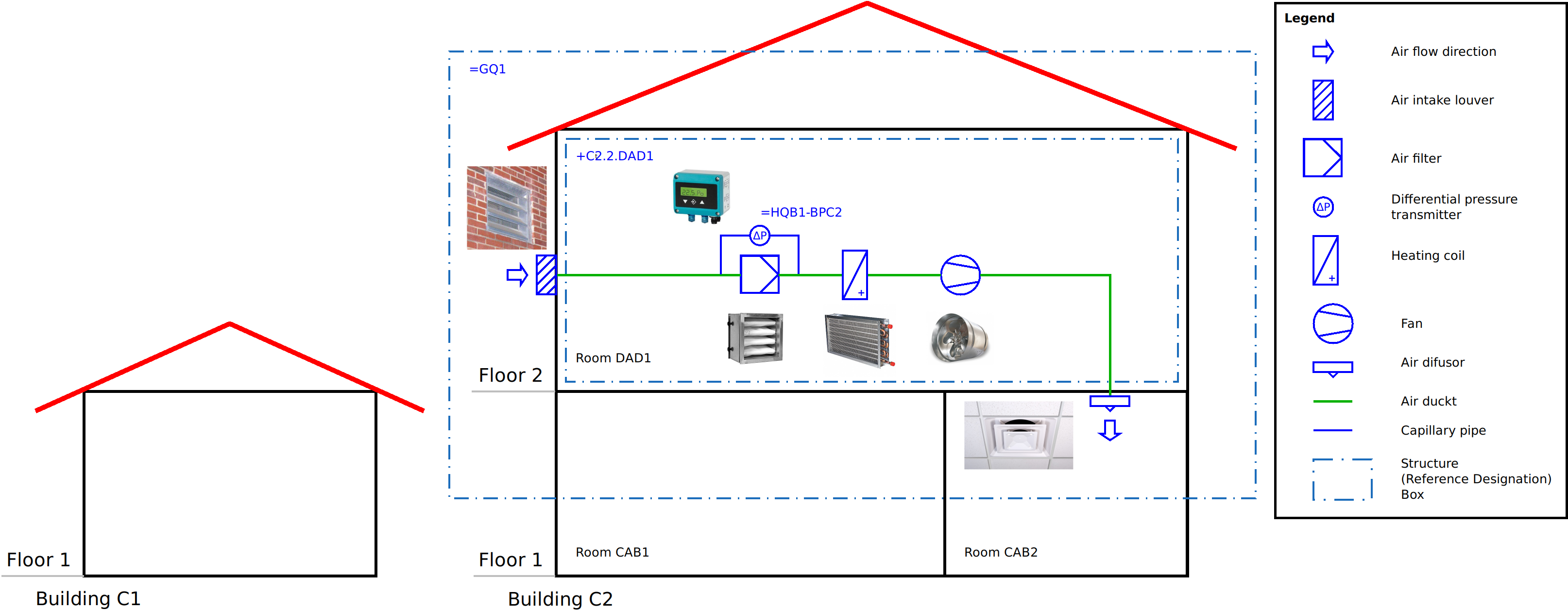
As we can see, we can store a lot of information in a relatively short code. This is the greatest power of such systems. When you know the system you are dealing with, you can deduct a lot of information regarding devices on the field just by knowing their designation codes.
Now this sounds really useful and neat and quite simple once you grasp a proper understanding on how the system works. The only problem it is, … there is way more different systems out there as you might think.
Standards and practice on field
Officially and on base of my work in the field so far, it seems that there is one main international standard that we can recognize by the number (DIN/EN/IEC) 81346(-X). Te standard is relatively recent, but taking in account it’s predecessors (DIN 6779 and DIN 40719-2) I could trace it history back to the year 1978.
As we can see the standard in all of its incarnations had a relatively long time to evolve and so it did. In practice it means that we have in different plants and industrial campuses stuck in different evolutionary branches of the same standard, according to the year of adoption. To make the things even more interesting, different companies tend to evolve the naming system further, according to their peculiar needs, situations and understanding of the standard itself.
There is always something to learn.
Reference designation systems and ePlan preplanning
The reference designation system according to IEC 81346 edition 2018 and it’s older iterations are supported quite well in ePlan P8 as well as in ePlan Preplanning.
- It is possible to use different existing aspects (place, function, …) of the standard and even to create custom ones.
- It is possible to adapt in detail all aspects of naming, like:
- Page numbering and subsequent inheritance
- Support for different automated numbering systems for different device types
- Define which aspects do apply to which device types
However the IEC 81346 edition 2018 is not supported in its entirety as this edition was not officially released yet (in the time of writing of this article is the most recent version of ePlan 2.8. and of IEC 81346, the edition 2017).
In general ePlan gives us high flexibility in this regard and a rich tool set to tackle all of the challenges we might encounter by different clients.
Conclusion
As we can see RDS is a very wide and interesting topic. Also a crucial part in the preplanning process. Therefore I decided to prepare a series of articles on the topic. The goal is to enlighten the different theoretical and practical aspects on the topic, which might fall into the category “good to know”. As we can see from this short intro, there is a lot to cover here.
In case you would like to learn more on the topic, you are welcome to connect with me on the following social media:
Xing
LinkedIn
Twitter
End note
The text above is written according to personal experience and available literature.
If your experience differs from mine or the information that is available to you differs from mine, please feel free to share it with me and to open a discussion in the comment section below, I will be happy to learn something new.
The same goes for any eventual questions or suggestions to improve the blog. The text above is written according to personal experience and available literature.
 iGeneering
Leave a comment